Inventor of the infinity symbol,
Inventor of the greater than or equal to,
Partial credit for the invention of infinitesimal calculus
(Infinite calculations)
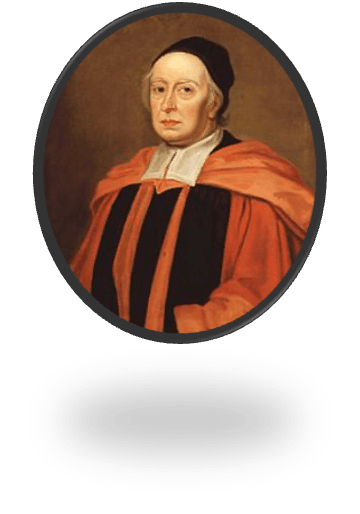
John Wallis was born on 3rd December 1616 in Ashford. He was the third of five children from Reverend John Wallis, and Joanna Chapman. He originally went to school in Ashwood but moved to James Movat’s School in Tenterden. Due to an outbreak of a plague. He first learnt about mathematics in 1631 at Felsted school.
John Wallis was an ordained clergyman of the church a specialised in not only maths, but English grammar, theology, and music theory as well.
He studied at Cambridge University and received a BA (Batchelor of arts) and MA (Master of arts) in 1637 and 1640. He was in a parliamentary party and was chief cryptographer with the royal court. He started developing his skills in mathematics after he began working with parliament. He then consequently moved to London, and this is when he began to take maths seriously. He made significant contributions to mathematic fields such as trigonometry, calculus, geometry, and the infinite series. Wallis then became the Savile Professor of Geometry at Oxford University in 1649 and he held this position for fifty-four years until his death. His book, Opera Mathematica (As shown in the image below) introduced the theory of the continued fraction. Apart from this he is credited (generally) for being the founder of the famous number line.
In 1656, he published in a book called De Sectonibus conicis (The Conic Sections), he published his discovery on the algerberic formulas for the parabola, ellipsis, and hyperbola. His work was an incredible and significant advance in the groundbreaking work of René Descartes who demonstrated how geometric lines can be translated and transformed into algerberic sequences in his book called La Gèomètrie in 1637.
During his prominent work on the Treatise of the Conic Sections, the infinity symbol was invented and introduced. He was also an active member in weekly scientific meetings that lead to the forming of the Royal Society by the charter by King Charles II in 1662. John Wallis published another book called Arithmetica Infitorium (which means Infinitesimal Arithmetic) was published in 1656 and this was seen as his greatest mathematical work during his life. His book Arithmetica Infitorium was a vital part and stage in integral calculus which made this very and highly influential. In 1665, a twenty-two-year-old Isaac Newton generalized John Wallis’s work and that was how he made his first major discovery called; The Generalized Binormal Theorem. Newton’s copy of the famous Arithmetica Infitorium with addition to his own comments in the margin of pages still exists today. The Wallis Product Can be found in Arithmetica Infitorium and this shows Wallis’s theory about how odd and even (n) could show but he could not prove rigorously that π is an infinite number. This was only the second time that π had been expressed as an infinite product. It was first done by a man called François Viète in 1593.
 Children's Chronicles